Stay informed with the latest news
Subscribe to our Telegram channel

Previously, August 1 was an important date for applicants. On the same day, the level of knowledge of applicants prepared for entrance exams for months and years was determined. That dreadful date had long since been forgotten. Now applicants can easily enter the exam by scoring maximum points in the main subjects before the start of the entrance exams.To do this, they must pass the national certification exam in general education subjects.
What is a national certificate?
A certificate is a test designed to determine the applicant's knowledge in general education subjects. The exam is administered by the Knowledge and Skills Assessment Agency (formerly DTM). Persons who have scored at least 60% of the highest score on the result of the test will be issued a certificate valid for 3 years.
Applicants with this certificate will be awarded the following points upon admission to the bachelor's degree program of higher educational institutions:
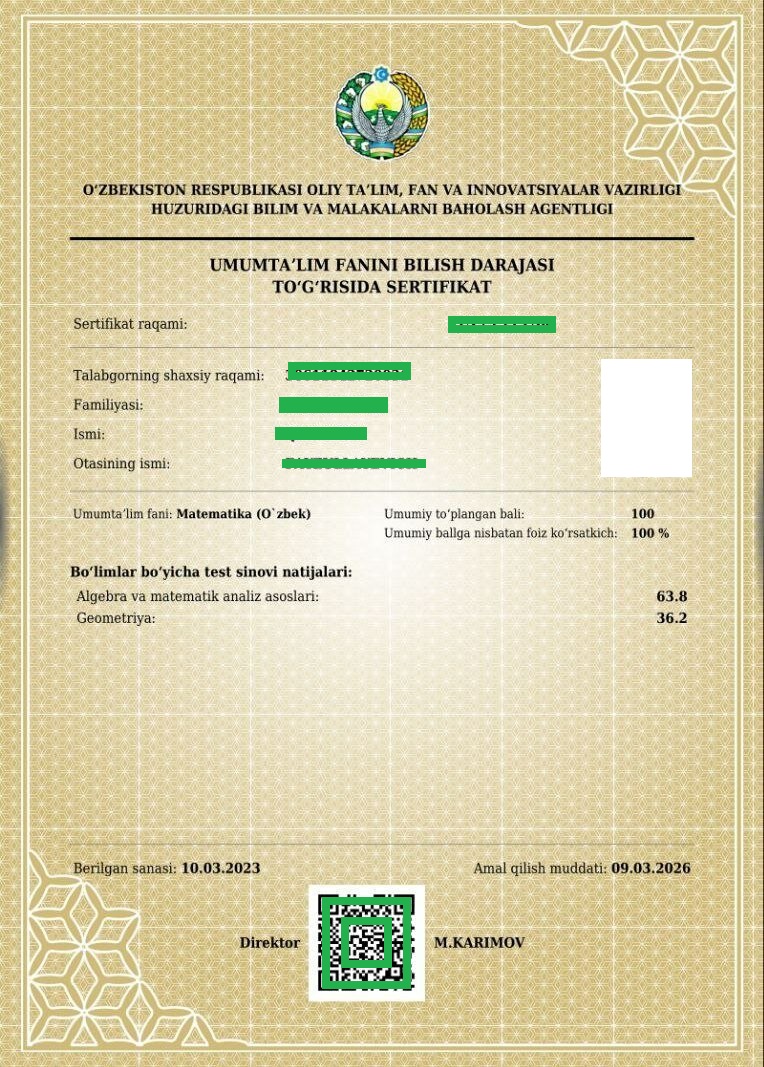
A candidate's certificate score above 60 percent is sufficient to obtain the maximum score set for a compulsory subject. For example, if an applicant who wants to apply for a medical degree has already received a certificate in chemistry and biology, he can only complete the test assignments in the mandatory subjects without completing the tests in the main block on the entrance exam. Or, if the applicant who is applying for economics has received a certificate in mathematics before the exam and its percentage is above 86, they will be exempt from test questions related to mathematics in both the main block and the block of compulsory subjects.
However, if the applicant's certificate score is below 86 percent, when applying to the university, he can obtain the maximum score in the subject of mathematics in the block of compulsory subjects and choose the option of working with questions in the subject of mathematics in the main block.
How are questions structured?
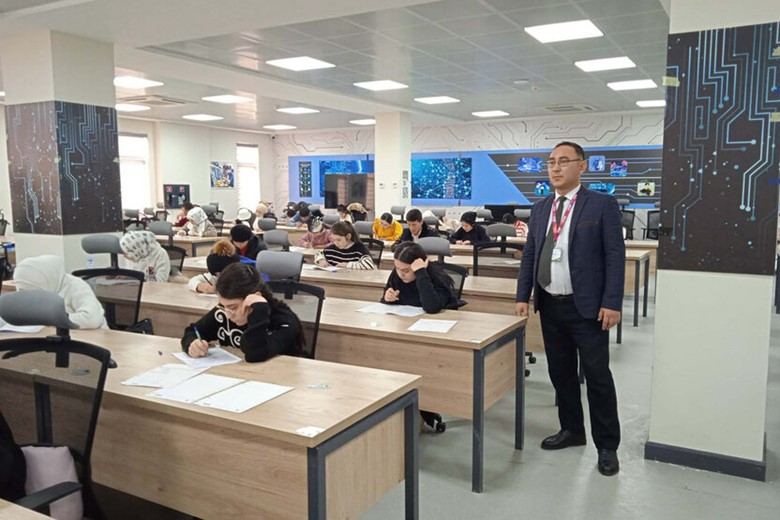
The exam questions for the national certificate must be structured in accordance with the state educational standards and curricula. Sample questions can be found on the website of the Knowledge and Skills Assessment Agency (formerly the State Educational and Scientific Center).
The questions on the certificate examination differ from those on the entrance examination. For example, applicants will also need to write essays during the exam in the subject of native language and literature. There are also more questions that test their ability to think logically.
How much time is given for the exam?
At the National Certificate Examination, 150 minutes (2 hours and 30 minutes) are allocated for 35 closed and 10 open types of test assignments (each of which is divided into parts A and B). Since open-ended test assignments are divided into two parts, considering the total number of test assignments as 55, each test assignment takes approximately 2 minutes and 44 seconds. Since writing an essay is required only on the subject of native language and literature, 3 hours are allocated for completing the assignments.
Does it have payment?
A fee of 450 thousand soums is currently charged for a certificate in the amount of 1.5 times the BCA. However, you may not be able to get a certificate without paying and participating in the exam and not getting the required score (above 60%). This is the difference from some exams, such as the IELTS exam. You can still get a certificate, even if it's low based on your IELTS score.
Responses will be published no later than 20 working days, and the certificate of the person who took the exam can be downloaded electronically through his personal account on the website of the Agency for Assessment of Knowledge and Skills. 
RECOMMENDERS NOTICE
1. The day of testing must come no later than the time specified in the permit with the original of the applicant's identity document (citizen's passport).
2. An applicant whose identity is not verified and who arrives late is not allowed to take the test.
It is strictly forbidden to bring any textbooks, literature, telecommunications and technical means into the building and classroom where the tests will be held. It is prohibited to negatively influence the process of conducting a test with various actions: communicating with other applicants, tearing the pages of the question book, handing the question book to other applicants, continuing to write after the time allocated for the test is over, handing any item to another applicant. The applicant who does not comply with these requirements is disqualified from the test with an act.
4. It is forbidden to bring outerwear, bags, folders, etc. into the auditorium.
It is forbidden to open the question book before the responsible audience observer announces the start of the test.
6. It is forbidden for the responsible observer to ask questions during the test (all questions regarding the conduct of the test are given to the responsible observer before the start of the test).
7. It is prohibited to leave the audience without the permission of the responsible observer.
It is forbidden to take test materials out of the classroom.
9. If you believe that you have been given incorrect, non-compliant test materials, or if the test assignments are defective, immediately notify the audience supervisor before the test begins.
10. An applicant who has necessarily left the group at the time of passing the test will not be given additional time.
11. Compare the numbers of the answer sheet (test and written work), they should be identical. If the numbers are different, contact the audience supervisor.
12. If your health deteriorates during the test, promptly notify the audience supervisor.
13. In case of late or unreasoned non-appearance of the applicant for the test, the payment is refunded in the amount of 50 percent.
14. During the testing process, the applicant is allowed to take only one general education subject test at a time.
RECOMMENDERS NOTICE
1. The day of testing must come no later than the time specified in the permit with the original of the applicant's identity document (citizen's passport).
2. An applicant whose identity is not verified and who arrives late is not allowed to take the test.
It is strictly forbidden to bring any textbooks, literature, telecommunications and technical means into the building and classroom where the tests will be held. It is prohibited to negatively influence the process of conducting a test with various actions: communicating with other applicants, tearing the pages of the question book, handing the question book to other applicants, continuing to write after the time allocated for the test is over, handing any item to another applicant. The applicant who does not comply with these requirements is disqualified from the test with an act.
4. It is forbidden to bring outerwear, bags, folders, etc. into the auditorium.
It is forbidden to open the question book before the responsible audience observer announces the start of the test.
6. It is forbidden for the responsible observer to ask questions during the test (all questions regarding the conduct of the test are given to the responsible observer before the start of the test).
7. It is prohibited to leave the audience without the permission of the responsible observer.
It is forbidden to take test materials out of the classroom.
9. If you believe that you have been given incorrect, non-compliant test materials, or if the test assignments are defective, immediately notify the audience supervisor before the test begins.
10. An applicant who has necessarily left the group at the time of passing the test will not be given additional time.
11. Compare the numbers of the answer sheet (test and written work), they should be identical. If the numbers are different, contact the audience supervisor.
12. If your health deteriorates during the test, promptly notify the audience supervisor.
13. In case of late or unreasoned non-appearance of the applicant for the test, the payment is refunded in the amount of 50 percent.
14. During the testing process, the applicant is allowed to take only one general education subject test at a time.
In which subjects can a national certificate be obtained?
We again touched upon the topic of the national certificate, which provides an opportunity for applicants to receive ready-made scores on the exam and a bonus for teachers. In this article, we will provide you with more information about the national certificate. Applicants can take the exam for a certificate in the following subjects and cash out the points in advance:

At a press conference attended by the Minister of Higher Education, Science and Innovation Kongratboy Sharipov, the entire public was informed that the levels of the national certificate for higher education and subsequent courses (master's and doctoral studies) were updated last year. According to which:
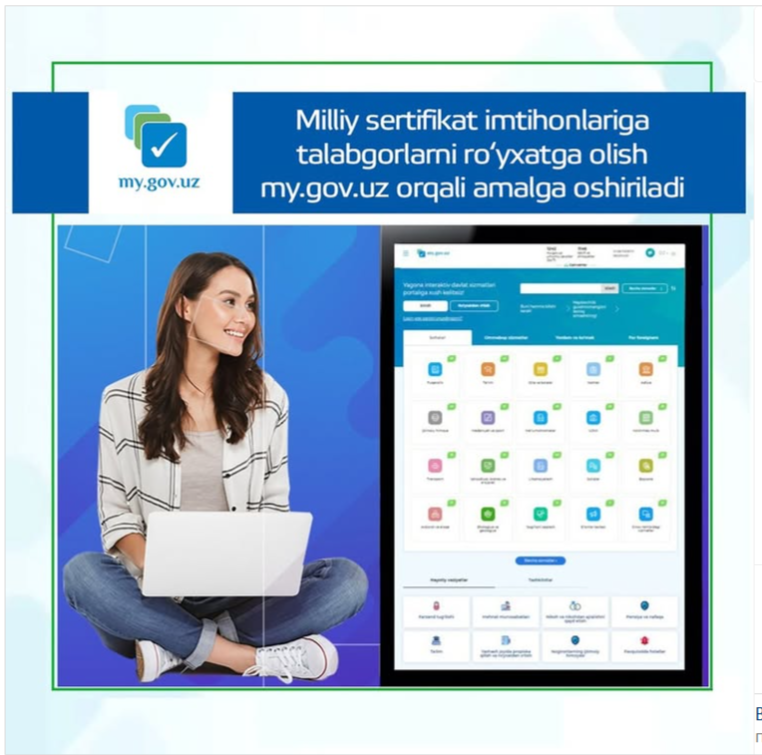
National Certificate Examinations are held annually in two stages in the first half of the year (September, October, November, December) and the second half of the year (January, February, March, April, May) by the Knowledge Assessment Agency. Applicants register through the website of the Unified Portal of Interactive Public Services my.gov.uz and pay for the exam.
If applicants who have already earned a certificate and a point in any subject are reading this article, please write to us about your impressions.
Prepared by Ma'mura Turaeva
#Article